

Adapting to the Era of Multi-Database Environments: Challenges
From the early days of flat-file systems to the contemporary era of cloud-based and distributed databases, the evolution of data storage and retrieval has been an extraordinary journey. With the fast-paced growth of technology, Businesses & Individuals have started to navigate towards having In House or a Cloud database. The pivotal role of databases in not just storing but harnessing and analyzing information has become more pronounced than ever. As a result, there is a growing need for data scientists and analysts to be able to connect to and access data from a variety of different databases.
Initially, companies often operated with a single, centralized database to manage their entire spectrum of data. However, the transition to multiple databases has become a strategic shift driven by various factors. The growth in data volume and diversity, coupled with the need for specialized handling of different types of information, has outpaced the capabilities of a singular database structure. With the advent of diverse data formats, varying access patterns, and scalability demands, companies have found it more efficient to adopt multiple databases, each tailored to specific needs. These databases might encompass relational databases for structured data, NoSQL databases for unstructured or semi-structured data, in-memory databases for swift data access, and specialized databases for some specific applications. This shift allows Organizations to have enhanced performance, scalability, and flexibility, ensuring that each database is optimized for the specific data it manages, ultimately empowering organizations to better meet their varied business requirements.
When Companies start to operate in multiple databases, New Problems started to arise related to Interoperability and Integration. Different databases may have distinct architectures and structures, which can hinder seamless interoperability. Integrating and ensuring smooth communication between these databases often requires complex middleware and can lead to increased development time and costs.
Exploring KNIME’s Extensive Database Integration Capabilities: Solution
KNIME is a powerful open-source data analytics platform that provides a wide range of tools for Data Science, Machine Learning along with data preparation, analysis, and visualization. KNIME is an integration platform making substantial strides in empowering users to connect to multiple databases simultaneously, fostering a seamless data-driven experience.
KNIME empowers users to access data from a wide variety of database systems, both traditional and cloud based. KNIME’s database connectivity is well-regarded for its ability to seamlessly integrate with diverse database systems, making it a versatile solution for modern data professionals.
Ways to achieve diverse database connectivity in KNIME:
- Using JDBC connector node:The JDBC connector node allows KNIME to connect to any database that has a JDBC driver. This means that KNIME can be used to connect to a wide range of different databases, including relational databases, NoSQL databases, and cloud-based databases.

- Using third-party database connector:There are several third-party database connectors available for KNIME. These connectors allow KNIME to connect to specific database types, such as Oracle, SQL Server, and MySQL.

Both the types of Connectors together provide remarkable compatibility to connect to diverse databases. These Databases Includes:
- Traditional Databases:
- Teradata: KNIME seamlessly connects to Teradata, allowing users to harness the power of Teradata’s data warehousing capabilities for in-depth analysis.
- SQL Server: KNIME offers robust integration with Microsoft SQL Server, making it a go-to choose for organizations relying on this popular database system.
- MySQL: KNIME’s compatibility with MySQL ensures that users can effortlessly access and manipulate data stored in this widely used open-source relational database.
- Oracle: For businesses relying on Oracle databases, KNIME’s connectivity simplifies data extraction, transformation, and analysis processes.
- PostgreSQL: KNIME seamlessly integrates with PostgreSQL, enabling users to work with data stored in this powerful, open-source database management system.
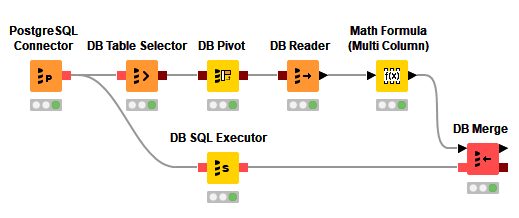
- SQLite: KNIME’s capability to connect to SQLite databases ensures that users can work with data in lightweight, file-based databases with ease.
- Vertica: KNIME’s support for Vertica databases allows users to leverage the speed and scalability offered by this column-oriented analytical database.
- Cloud Databases:
- Amazon Redshift: With its compatibility with Amazon Redshift, KNIME facilitates the seamless utilization of Amazon Web Services’ data warehousing service for cloud-based data storage and analysis.
- Amazon Athena: KNIME’s integration with Amazon Athena, a serverless, interactive query service, empowers users to perform ad-hoc queries on data stored in Amazon S3 with ease.
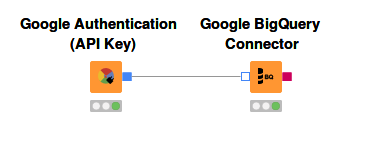
- Google BigQuery: KNIME is compatible with Google BigQuery, enabling users to harness Google’s fully managed, serverless, and highly scalable data warehouse for analytics.
- Additional Databases:
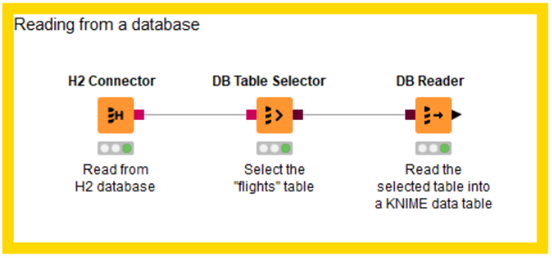
- H2: KNIME’s ability to connect to H2 databases makes it a versatile choice for users who rely on this lightweight, embeddable Java database.
- Microsoft Access: KNIME streamlines data connectivity with Microsoft Access, making it suitable for users who maintain their data in this database system.
KNIME’s capability to read and integrate data from structured databases, flat files, web services, and cloud-based databases ensures that users can seamlessly work with data from multiple sources without the need for complex data transformation processes.
Empowering Seamless Integration: Benefits of KNIME In Diverse Database Connectivity
By providing a user-friendly interface and a rich set of functionalities, KNIME significantly reduces the challenges of working across multiple databases, fostering efficiency and flexibility in data analytics, transformation, and visualization. Through its visual workflow design, scalable architecture, and extensive support for various database systems, KNIME paves the way for organizations and data professionals to harness the true potential of their data resources in an increasingly interconnected world. With the ability to connect to diverse databases in KNIME, It helps in harnessing following benefits to its users:
- Increased flexibility and agility: KNIME users can connect to and access data from a variety of different database types, regardless of the underlying database technology. This gives users the flexibility to choose the best database for their specific needs.
- Improved data quality and accuracy: KNIME users can combine data from multiple databases into a single dataset for analysis. This can help to improve the quality and accuracy of the data, as well as the insights that can be gained from it. For example, a financial services company may use diverse database connectivity in KNIME to combine customer data from its CRM system with transaction data from its core banking system. This would allow the company to get a more complete view of each customer’s financial activity and identify patterns and trends that would not be possible to see if the data were siloed in separate databases.
- Reduced costs and complexity: KNIME users can eliminate the need to purchase and maintain multiple data integration tools. This can help to reduce costs and complexity and make it easier to manage and maintain data. For example, a large enterprise may need to connect to hundreds of different databases. With diverse database connectivity in KNIME, the enterprise can use a single tool to connect to all its databases and eliminate the need to purchase and maintain multiple data integration tools.
- Enhanced data governance and security: Diverse database connectivity in KNIME can help organizations to improve their data governance and security practices. For example, organizations can use KNIME to implement data access controls and encryption to protect their sensitive data. Organizations can also use KNIME to audit data access and track how data is being used.
- Improved decision-making: Diverse database connectivity in KNIME can help organizations to make better decisions by giving them access to all their data, regardless of where it is stored. For example, a retail company may use diverse database connectivity in KNIME to combine data from its customer relationship management (CRM) system, point-of-sale (POS) system, and e-commerce platform. This would allow the company to get a complete view of each customer’s purchase history and preferences. The company could then use this data to make better decisions about pricing, promotions, and product development.
In summary, KNIME’s prowess in diverse database connectivity simplifies the process of unifying data from various sources. The platform bridges the gap between traditional and cloud databases, offering users a cohesive and user-friendly experience. With the ever-expanding array of data sources in today’s world, KNIME’s ability to connect to multiple databases, including Amazon Redshift, Amazon Athena, Google BigQuery and Others is a key feature that empowers data professionals to effectively access and work with data from diverse origins.