
What is Vector Databases and Vector Search?

Vector databases are becoming increasingly vital in the realm of generative AI (GenAI) and machine learning, enabling efficient storage, retrieval, and processing of high-dimensional data. Let’s explore more into what they are, their significance, popular options, and how they boost GenAI adaptation.
What are Vector Databases?
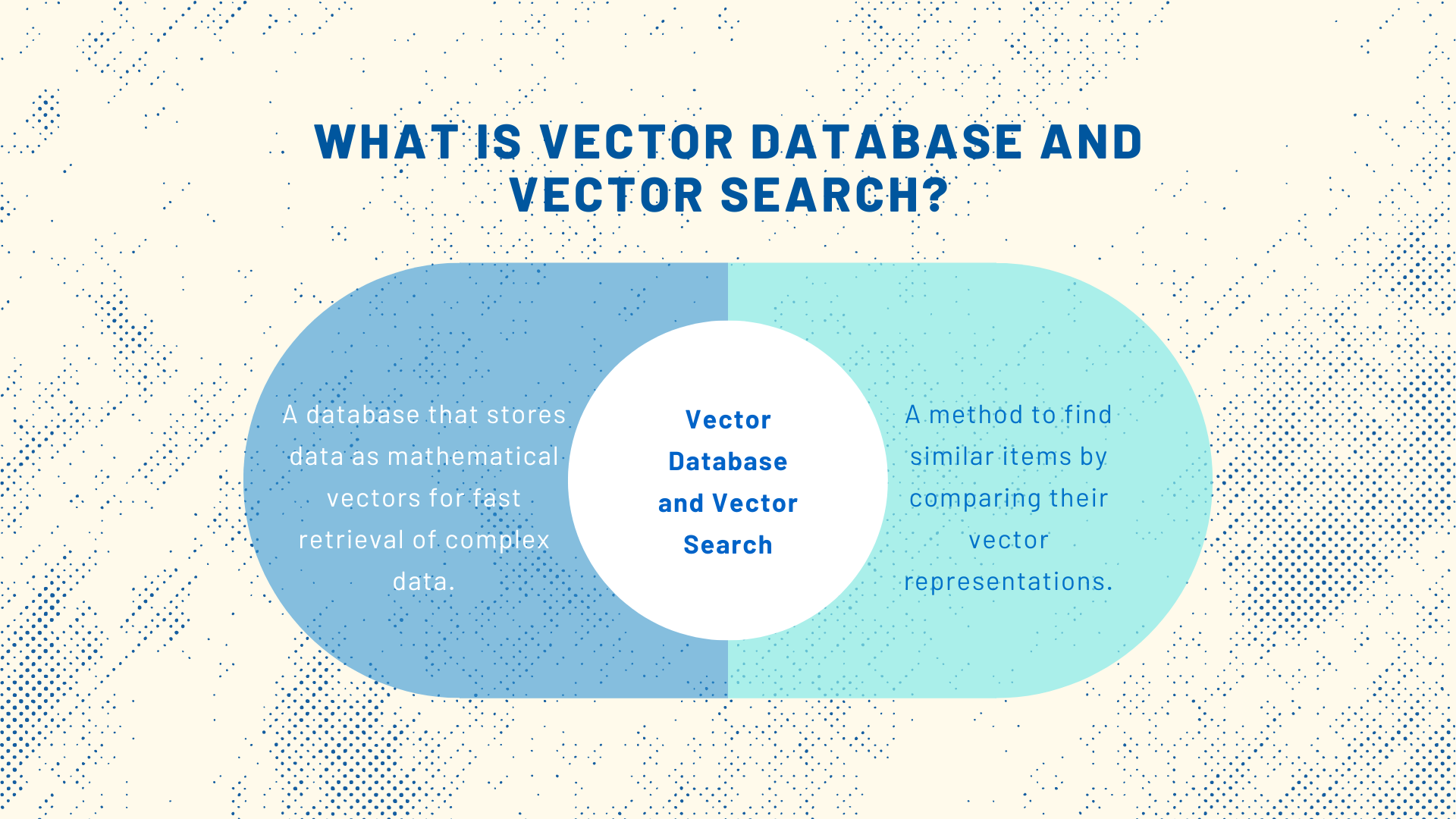
- Vector databases are specialized databases/systems designed to store and manage vector embeddings.
- Vector embeddings essentially converts the data into a numerical format of while capturing semantic information as well.
- Unlike traditional databases, which handle scalar data (like integers or strings), vector databases excel at managing complex, high-dimensional data, making them essential for applications in AI and machine learning. These databases enable fast and accurate similarity searches, allowing for efficient retrieval based on the proximity of vectors in a multi-dimensional space.
Popular Vector Databases
As of 2024, several vector databases stand out for their performance and scalability:
1. Pinecone: A fully managed service optimized for similarity searches, widely used by companies like Microsoft and Shopify. It offers high performance and seamless integration with existing workflows.
2. Milvus: An open-source database designed for massive-scale vector data, supporting both nearest neighbor search (NNS) and approximate nearest neighbor search (ANNS). It is favored by organizations like Airbnb and PayPal for its flexibility and community support.
3. Qdrant: This advanced vector search engine is tailored for high-dimensional data processing, providing real-time updates and precise search capabilities. Companies like Discord and Johnson & Johnson utilize Qdrant for its efficient vector storage.
4. Chroma: Known for its versatility, Chroma excels in managing high-dimensional data and is optimized for AI applications, making it a popular choice among developers.
5. Weaviate: A scalable vector database that integrates seamlessly with machine learning workflows, enabling powerful semantic search capabilities.
Vector Search
Itrefers to finding the similar items or retrieving information by comparing numerical vector representations of data. It is a method for searching through high-dimensional vector spaces to find vectors that are closest to a given query vector based on some similarity measure.
How Vector Search Works?
- Data Representation as Vectors through Embedding:
- First, data (such as text, images, or other items) is converted into a numerical form known as a vector.
- This is done using various methods, such as word embeddings (e.g., Word2Vec, GloVe) for text, or deep learning models (e.g., CNNs) for images.
- Each item is represented as a point in a high-dimensional space. For example, a document might be represented as a vector in a 300-dimensional space.
- Storing Vectors through Indexing:
- These vectors are stored in a database or an index.
- This index can be a specialized data structure designed to facilitate fast searching, such as an inverted index or an approximate nearest neighbor (ANN) index.
- Querying:
- The input text/data is converted into a vector when a query is made.
- The system searches for the vectors in the index that are most similar to the query vector.
Similarity Measures: The system then measures the similarity between the query vector and the stored vectors. Common similarity metrics include:
Cosine Similarity: Measures the cosine of the angle between two vectors, effectively capturing their directional similarity.
Euclidean Distance: Calculates the straight-line distance between two vectors in the vector space. Can be computationally expensive.
Dot Product: Measures the projection of one vector onto another, often used in conjunction with cosine similarity.
- Retrieving Results:
- Nearest Neighbor Search: The vectors with the highest similarity (or smallest distance) to the query vector are identified.
- This process is often accelerated using specialized algorithms like KD-trees, locality-sensitive hashing (LSH), or approximate nearest neighbor (ANN) techniques.
- Returning Results:
- Ranked List: The search results are usually returned in order of similarity, with the most similar items appearing first.
Instrumental Role in GenAI Applications
Vector databases are crucial for GenAI applications, as they allow for:
– Semantic Search: By converting text and other data into vectors, these databases enable searches that understand context and meaning, improving the relevance of search results.
– Recommendation Systems: They facilitate personalized recommendations by quickly identifying similar items based on user preferences and behaviors.
– Image and Video Retrieval: Similarity search for images or videos recommendations.
– Chatbots and Conversational AI: Vector databases support the deployment of large language models by providing the necessary infrastructure for storing and retrieving vast amounts of vector embeddings, resulting in better user interactions with more accurate and contextually relevant responses.
Challenges
- High Dimensionality: Working with high-dimensional vectors can be computationally intensive.
- Approximation: To speed up searches, some methods use approximations that might not always return the exact nearest neighbors.
In summary, vector databases are transforming how we manage and utilize data in the age of AI, making them indispensable tools for any organization looking to leverage the power of generative AI and machine learning.